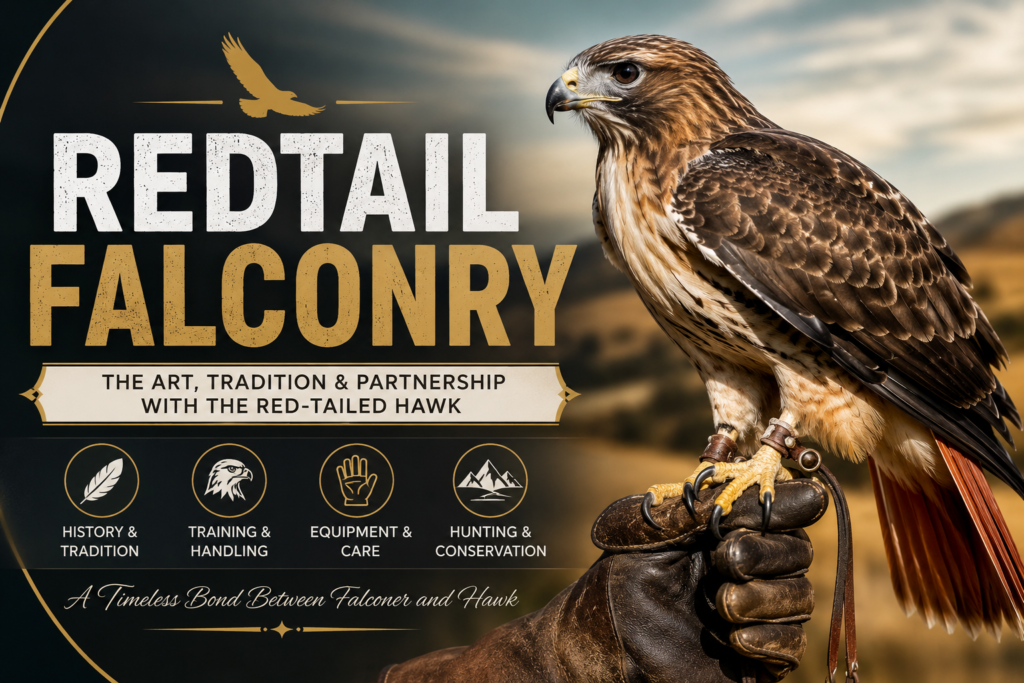
Falconry is one of the oldest forms of human interaction with birds of prey. For centuries, people have developed a unique partnership with raptors, learning how to care for, train, and fly them while respecting their natural instincts. Among the birds used in this tradition, the red-tailed hawk is especially well known for its strength, intelligence, adaptability, and impressive hunting abilities.
Redtail falconry refers to the practice of working with a red-tailed hawk within the traditional discipline of falconry. Although the red-tailed hawk is technically a hawk rather than a true falcon, it has become an important and popular bird among falconers, particularly in North America.
If you are interested in learning about redtail falconry, understanding the bird itself is the best place to start. This guide explores the characteristics of the red-tailed hawk, its role in falconry, training principles, care requirements, legal considerations, and what it takes to become a responsible falconer.
What Is a Red-Tailed Hawk?
The red-tailed hawk (Buteo jamaicensis) is a large bird of prey native to North America. It is one of the continent’s most recognizable raptors and can be found in a wide variety of habitats, including grasslands, forests, deserts, farmland, and open countryside.
The bird gets its common name from the distinctive reddish-brown coloration of the tail that develops in mature individuals. Its broad wings and relatively short tail give it a powerful appearance, while its excellent eyesight allows it to locate potential prey from considerable distances.
Red-tailed hawks primarily eat small mammals such as rodents and rabbits. Depending on their habitat and opportunities, they may also consume birds, reptiles, and other small animals.
Their adaptability is one of the reasons they have remained successful in environments that have changed significantly due to human development.
Why Are Red-Tailed Hawks Used in Falconry?
Red-tailed hawks have several characteristics that make them suitable for experienced falconers. They are powerful birds capable of hunting prey on the ground, and they can adapt to a variety of environments.
One of their major advantages is their versatility. Unlike some specialized raptors that are primarily associated with particular hunting techniques, a red-tailed hawk can use several natural hunting behaviors. It may perch patiently while watching an area, soar above open land, or pursue prey when an opportunity appears.
Their size and strength also make them capable of handling relatively substantial prey compared with many smaller raptors.
However, these qualities should not be confused with domestication. A red-tailed hawk remains a wild animal with powerful instincts. Successful falconry depends on developing trust and communication while respecting those instincts rather than attempting to turn the bird into a conventional pet.
The Relationship Between a Falconer and a Red-Tailed Hawk
One of the most fascinating aspects of redtail falconry is the relationship between the falconer and the bird.
Falconry is not simply about owning a bird of prey. It involves responsibility, patience, observation, and an understanding of the bird’s behavior. The falconer must learn to recognize changes in appetite, posture, activity, and temperament.
A good falconer does not rely solely on commands. Instead, they develop an understanding of how the bird responds to its surroundings and how motivation, routine, and environmental conditions influence its behavior.
Trust is developed gradually. The bird must become comfortable around the falconer, equipment, handling procedures, and normal daily activities. This process requires consistency and careful attention.
Training a Red-Tailed Hawk
Training a red-tailed hawk is a gradual process rather than something that can be accomplished quickly.
The early stages generally focus on helping the bird become accustomed to human presence and routine handling. Falconers carefully introduce appropriate equipment and establish predictable interactions.
As the bird becomes comfortable, training can progress toward controlled responses and flying exercises. The objective is to create a reliable partnership in which the bird voluntarily responds to the falconer’s signals and returns appropriately.
Experienced falconers pay close attention to the bird’s condition throughout training. Stress, illness, poor nutrition, or unsuitable environmental conditions can negatively affect both performance and welfare.
For this reason, training should always be conducted under appropriate supervision and according to established falconry standards.
Equipment Used in Redtail Falconry
Falconry requires specialized equipment designed to protect both the bird and the handler. Traditional equipment may include a suitable falconry glove, jesses, swivels, perches, and other handling and management tools.
A falconry glove protects the handler’s hand and provides a stable surface for the bird. Jesses and related equipment are used within accepted falconry practices to help manage the bird safely when appropriate.
Perches are also important because raptors require suitable resting areas that support their feet and allow them to maintain healthy posture.
Modern falconry may additionally involve tracking equipment, particularly when a bird is flown outdoors. Tracking technology can help a falconer locate a bird if it travels farther than expected.
Equipment should always be properly fitted, maintained, and used by someone who understands its purpose. Incorrect equipment can cause injury or unnecessary stress.
Diet and Nutrition
Proper nutrition is one of the most important responsibilities in redtail falconry.
Red-tailed hawks are carnivorous predators and require an appropriate diet that reflects their nutritional needs. Falconers must provide suitable food while maintaining careful control over the bird’s overall condition.
Nutrition is not simply about providing enough food. The quality, freshness, storage, and suitability of food all matter. Clean water and hygienic feeding practices are also essential.
A bird’s physical condition can have a significant impact on its health and behavior. Responsible falconers therefore monitor their bird closely and seek professional veterinary advice whenever health concerns arise.
Health and Daily Care
Caring for a red-tailed hawk requires a long-term commitment.
Falconers need to provide a safe environment, appropriate housing, suitable perches, proper nutrition, and regular observation. The bird’s feet, feathers, eyes, beak, and general condition should be monitored for signs of injury or illness.
Raptors can hide signs of illness, which means subtle behavioral changes may be important. A responsible falconer should have access to a veterinarian with appropriate experience in treating birds of prey.
Clean surroundings are equally important. Poor hygiene can contribute to health problems, while unsuitable housing may damage feathers or cause physical injuries.
The bird’s welfare should always come before the desire to fly or hunt it.
Redtail Falconry and Hunting
Traditional falconry is closely connected with hunting, but responsible modern falconry places significant emphasis on conservation, animal welfare, and legal compliance.
A red-tailed hawk may naturally hunt small mammals, but a falconer must understand the difference between natural behavior and responsible managed practice. Hunting opportunities should only occur where they are legal, ethical, and appropriate for the bird.
The goal is not simply to catch prey. A successful falconry partnership involves understanding the bird’s natural abilities and allowing those abilities to be expressed in a controlled and responsible setting.
Is Redtail Falconry Legal?
Legal requirements are an essential part of falconry.
In many places, keeping and flying birds of prey requires permits, licenses, examinations, inspections, or participation in recognized falconry programs. Regulations can differ considerably between countries, states, provinces, and local jurisdictions.
Wild red-tailed hawks may also be protected under wildlife laws. Capturing, possessing, transporting, selling, or releasing a raptor without the appropriate authorization can result in serious legal consequences.
Anyone interested in redtail falconry should therefore contact the relevant wildlife authority before acquiring or handling a bird.
It is never appropriate to take a wild raptor simply because it appears suitable for falconry.
How to Get Started With Falconry
For someone new to falconry, the best starting point is education rather than acquiring a bird.
Find a recognized local falconry organization, learn about the applicable laws, and speak with experienced falconers. In jurisdictions where apprenticeship programs are required, beginners may need to work under the guidance of an experienced falconer before they can independently keep a bird.
This apprenticeship period is valuable because books and online articles cannot fully replace practical experience. Beginners need to learn how to handle equipment, assess a bird’s condition, maintain appropriate housing, prepare food, and respond to unexpected situations.
Falconry requires time and commitment, so prospective falconers should understand the responsibilities before deciding to participate.
Conservation and Respect for Birds of Prey
One of the most important principles of modern falconry is respect for wildlife.
Responsible falconers contribute to a culture that values healthy raptor populations and sustainable wildlife management. Learning about habitat loss, environmental threats, migration, and disease can help falconers understand the broader ecosystem in which these birds live.
A red-tailed hawk is not merely a hunting companion. It is a wild predator with an important ecological role.
Respecting that role is essential to ethical falconry.
Red-Tailed Hawk vs. True Falcons
Despite the phrase “redtail falconry,” it is worth clarifying that a red-tailed hawk is not actually a falcon.
Falcons belong primarily to the genus Falco, while the red-tailed hawk belongs to the genus Buteo. Both are birds of prey, but they have different body structures and hunting strategies.
Falcons are often associated with high-speed aerial pursuits, while red-tailed hawks are particularly well adapted to soaring, perching, and hunting terrestrial prey.
This distinction is useful for anyone researching falconry because the word “falconry” traditionally describes the broader practice of working with trained birds of prey, not only birds scientifically classified as falcons.
Why Redtail Falconry Continues to Fascinate People
Redtail falconry combines wildlife observation, tradition, skill, and a deep appreciation for nature.
For many enthusiasts, the most rewarding part is not simply seeing a bird fly. It is learning to understand another animal’s behavior and developing a respectful working relationship with it.
The red-tailed hawk’s impressive flight, powerful presence, and natural intelligence make it a remarkable species to observe. Its ability to soar over open landscapes and use its environment to locate prey demonstrates the extraordinary adaptations of birds of prey.
Conclusion
Redtail falconry is much more than training a bird to fly from one place to another. It is a demanding tradition built around knowledge, patience, responsibility, and respect for wildlife.
The red-tailed hawk is a powerful and adaptable raptor that has earned an important place in falconry, particularly in North America. However, keeping and working with one requires appropriate knowledge, equipment, veterinary care, and—most importantly—compliance with local wildlife laws.
For anyone interested in this fascinating tradition, the best approach is to learn from experienced falconers, understand the legal requirements, and prioritize the bird’s welfare at every stage.
When practiced responsibly, redtail falconry can provide a unique opportunity to appreciate one of nature’s most remarkable predators while preserving the traditions and principles that have shaped falconry for generations.
Leave a Reply